Article: Lash Extensions for Hooded Eyes: Curls, Lengths & Lash Mapping
Lash Extensions for Hooded Eyes: Curls, Lengths & Lash Mapping
By Mariia Chebanenko, founder of MARY LASH, lash technologist with 18 years of experience and educator
Hooded eyes aren't a flaw — they're a natural anatomical feature every lash artist works with daily. Many techs see them as a challenge, but the right set of lash extensions can create a visual lift, open up the eye and disguise the hooding — no surgery needed. Here's how to adapt your technique to a heavy lid, which lashes give the best result, and which mistakes make the eye look heavier.
What hooded eyes are and why they're tricky
A hooded eye is when the skin of the upper lid folds over the mobile lid, sometimes touching the lash line. It can make the eye look tired or stern. Hooding can be genetic or develop with age and fatigue.
The main challenge: part of every extension "hides" under the fold. If you don't account for that, the result looks invisible — or the lashes poke the lid and make the client uncomfortable. For example, a 12 mm lash on a strongly hooded eye looks shorter than the same 12 mm on an eye without hooding. On average you lose 1–2 lengths, especially on monolid eyes or eyes with an epicanthic fold.
Assess the hooding: 3 levels
Before you start, check how much the fold covers the mobile lid, which direction the natural lashes grow (straight or downward), and the eye shape and set. This tells you which lashes to choose.
- Mild: the fold just touches the mobile lid.
- Moderate: the skin covers half or more of the mobile lid.
- Strong: the fold completely covers the mobile lid and rests on the lashes.
Choose the right curl
The right curl is about 70% of success when correcting hooded eyes.
- C curl — for mild hooding and naturally curled lashes.
- CC curl — the best option for lashes that grow straight or downward.
- L and L+ curl — a straight base and a sharp lift. Ideal for heavy lids: the base sits under the fold while the tip points up and opens the eye.
- M and V curl — softer than L but lifts the lid edge effectively for an open-eye look.
- D curl — the strong curl can touch the lid and irritate it, so keep it for the outer corners.

| Hooding level | Recommended curl | Effect |
|---|---|---|
| Mild | C, CC | Natural look |
| Moderate | CC, M | Corrects the fold |
| Strong | M, L, L+, V | Lifting effect |
The best length and thickness
Don't be afraid of length on hooded eyes. Because part of the lash hides under the lid, a standard 10 mm can look like 8 mm.
- Length: add 1–2 mm to your usual length so the lashes show from under the fold.
- Thickness: choose lightweight lashes — 0.07–0.10 mm — and build density with volume instead of thickness.
- Volume: ultra-natural sets can't fully correct hooding. 2D and up creates the density that visually opens the eye.
Shop lightweight MARY LASH lashes in the curls and lengths you need.

Lash mapping for hooded eyes
Effects that work
- Open eye / doll effect: the longest lashes sit in the center, right above the pupil. This visually enlarges the eye and opens the look.
- Even doll look: evenly opens the eye and helps hide the fold.
- Wispy / Kim K spikes: vertical accents draw attention away from the lid and create a textured, open look.

What to avoid
- Cat eye: on strong hooding, a long, dropped outer corner makes the eye look like it's "falling" — tired, sad and older.
- Flat curls (B, J): without enough lift, these lashes simply disappear under the skin. The client gets extra weight and no visible result.
"On hooded eyes, the curl does most of the work. Pick the lift first, then the length." — Mariia Chebanenko
Application technique and pro tips
- Control your distance from the lid: on hooded eyes keep it precise. If the extension sits too close, it touches the skin every time the client blinks — irritating the lid and shortening retention.
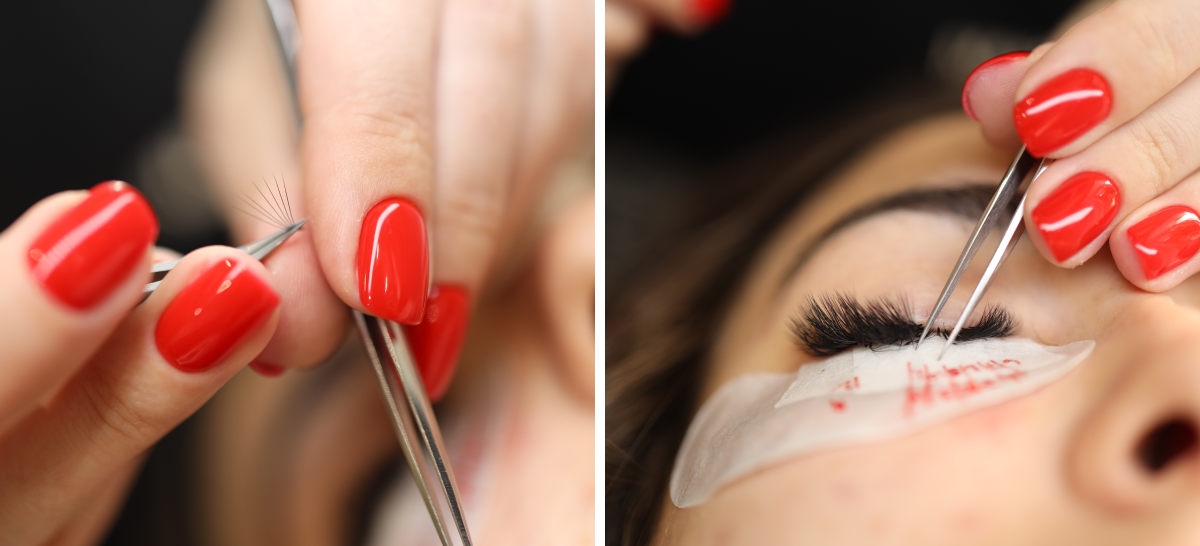
- Tape properly: lift the hooded skin gently with lash tape so you can see and isolate every natural lash, including the top rows.
- Place spikes where the fold is heaviest: this visually "breaks" the solid line of skin and creates the illusion of depth.
- Add volume where hooding is strongest: a denser row holds its shape better and covers the fold more effectively than single lashes.
The bottom line
Hooded eyes aren't an obstacle to a beautiful set — they're a chance to show your skill. The key is the right curl, length and mapping. You'll find everything you need for these sets at MARY LASH — from L and M curl lashes to reliable lash glue.
Want to master every eye shape? Train in person with Mariia at MARY LASH Academy in Fort Lauderdale, Florida.

About the author: Mariia Chebanenko
Lash artist with 18 years of experience, international lash champion, speaker and judge at leading beauty events. Founder of MARY LASH and MARY LASH Academy. Follow her on Instagram: @mary_chebanenko_usa.